The other week I drove from DC to the coast of Connecticut to join a
panel at the Poetry by the Sea conference honoring African American poet and novelist
Margaret Walker, whose works include the award-winning poem For My People (1942) and the novel Jubilee (1966), based on the story of her great-grandmother during the
slavery era. I learned about Walker while researching the book and documentary Soul of a People.
This year marks the centennial of Walker’s birth, and Jackson State
University, where she nurtured generations of writers for decades, has
organized a slate of events to celebrate. Hopefully the
world will know Walker’s vital work much better as a result.
I thank my friends at Turner Publishing for posting my piece Young People Finding a Passion for Expression about Walker and her surprising formative years as a young woman working with other writers in a depressed Chicago during the late 1930s. Read the post here.
Seventy years ago outside the soaring stone Louisiana capitol building in Baton Rouge, the governor gave an Arbor Day speech that linked planting a tree with securing liberty. Then he put his foot to a shovel to make it happen. What was that tree that would protect the American people? The cork oak!
Little-known fact: at the middle of the 20th century the United States imported nearly half the world’s cork. It was crucial (as an insulator) for the defense industry’s wartime production of planes, ships and equipment. For years during World War II and after, Arbor Day celebrations across the U.S. featured governors and other officials intoning to live and radio audiences how citizens could help keep America free by planting a cork oak. In response, 4-H groups, boy scouts and garden clubs requested the seedlings and planted trees to do their patriotic duty.
So for Arbor Day and its successor Earth Day, here’s a reprise of the quixotic tale of the wartime campaign to save the U.S. from Fascism by growing cork oaks across America! Thanks to Chesapeake Bay magazine for publishing this first installment of an elaborate tale of nature and national security.
And thanks to All Things Considered for airing another slant on the story.
Digging deeper, I have been intrigued to find more about how cork – that elusive substance of desire and wine stoppers native to the Mediterranean – was a big deal in the mid-1900s. Companies like Crown Cork and Seal and Armstrong Cork – both still going today in different forms – found their work with Nature's cork entailed unnatural geopolitics. What began as a simple trade in bark and bottle caps snowballed into an elaborate global drama, bringing along sabotage, espionage, and…
More to come. Do you have a cork oak story of your own?Let me know.
Happy Earth Day!
The Experience America exhibit at the Smithsonian American Art Museum blends, with a fresh eye, pieces from the museum’s permanent collections – including a number of stars from the Federal Works of Art Program exhibit of a few years ago, featured in my Smithsonian piece. Others come from private collections. Together these paintings help break down the silos separating images from the 1930s and '40s and portray America and American realism in a new light. It’s a refreshing and inviting exhibit.
Upstairs, the rooms devoted to Mingering Mike’s Supersonic Greatest Hits reveal a new form of outsider art: the LP oeuvre of a recording artist who never released a disc. The album covers track the career of a soul star from DC's streets, Mingering Mike. His vision comes complete with liner notes, lyrics
and cardboard records hand-painted with grooves suggesting hi-fi tunes the
appropriate length. You can also see his platinum hits. The exhibit is a
fascinating little gem. There’s a fun piece about the artist
on Studio 360.
For Veterans Day, the Baltimore Sun shares today the story that East Baltimore resident Frank DiCara told me about his experience during World War II and coming back.
Born into a family of six in the hardscrabble Highlandtown neighborhood, DiCara faced a tough road: By 1944 his three older brothers had all been drafted into the service, and he got his own draft notice just before Christmas that year. He was shipped off to the Philippines with all the other 18-year-old boys.
After surviving the war's ordeal, he faced more trials coming home. But a chance encounter changed his story and his life. What if he had missed that sidewalk meeting? he wonders. Thanks to the Sun for running the piece.
Last weekend marked the anniversary of one of the first encounters in the War of 1812, the battle between the U.S.S. United States and H.M.S. Macedonian. In researching our National Geographic book, Mark and I found some stories that surprised us, and one involved the wager of a beaver hat and lightning striking twice.
Stephen Decatur was commander of the Navy Yard in Norfolk, Virginia, before the war. There he would invite his British counterparts in port over for dinner. In January 1812 one of his guests was Captain John Carden, who commanded the H.M.S. Macedonian. That night over dinner, Decatur bet Carden a fine beaver hat that his ship, the United States, could best the Macedonian one-on-one. It was almost a joke: Decatur’s ship was nicknamed “the Old Wagon,” while the Macedonian, with 38 guns, was new and nimble.
They laughed, toasted and parted that night, expecting nothing to come of it.
Within months, everything had changed. That fall when Decatur, after crossing the Atlantic, bore down on a British ship, the other ship turned out to be none other than the Macedonian.
The Macedonian and the United States
It was Sunday, October 25. West of the Canary Islands. Confident in the Macedonian’s speed, Carden sailed straight at his opponent. And indeed, she sped past the United States' first shot. But Decatur used his position and the longer range of the U.S. guns (24-pounders compared to the British 18-pounders) to stay out of cannon range and dismast the Macedonian. Then he swooped in to finish the job. At that point we shift perspective to the British ship, where a boy named Samuel Leech, a powder monkey, quickly saw how brutal a sea battle could be. When the Macedonian’s crew had left Portsmouth heading for the Mediterranean, they didn’t even know that Britain was at war with the U.S. Suddenly they were in battle. My blog for NY Bound Books sometime ago takes up Leech’s tale.
It’s a tale that takes a young man through war to another land, another life, and a sudden jarring return to his old ship during a visit to New York, like a bad flashback. Rattled and moved, Leech was inspired to write his life story, Thirty Years from Home. His book came out in the 1840s and became a surprise bestseller. It still offers a remarkable firsthand glimpse from that time of life and death and second chances.
Happy to have my review of two fine Baltimore writers in the Washington Independent Review of Books. Rafael Alvarez and Clarinda Harriss share
a fascination with their city’s residents, how people use language, and the random
social encounters that cut across ethnicity and class. It’s fun to imagine the two authors, who both have new short story collections out, meeting for drinks and hashing things out in a
Baltimore bar (though probably not one in the Inner Harbor).
My new guest post on National Geographic's Intelligent Travel blog is about my trip to Kyrgyzstan, and stories of empires and herders that met in Central Asia along the Silk Road. It was a wild trip through the mountains - I hope you enjoy the read!
Please let me know what you think and post a comment on the Nat Geo site or here.
To mark Natonal Doughnut Day on June 6, thousands will trot to their neighborhood doughnut or donut shop for free samples. Here we mark it by revisiting my Smithsonian article on the humble doughnut's sprawling history, from the Dutch, Russian immigrants and Hollywood idols who played a part.
In the last few months I've been gratified to hear from more writers and readers who have enjoyed it and even been inspired by the story. Enjoy the day.
My thanks to Erin Allen and the staff at the Library of Congress for featuring this Q&A about the Federal Writers' Project and the event at the Library showcasing the WPA writers' legacy in oral history with the 75th anniversary of the publication of These Are Our Lives, which first appeared in May 1939.
The event features Ann Banks, author of First-Person America (now available on Kindle), Virginia Millington from StoryCorps, and actors John Stange and Eternanda Fudge, courtesy of DC's Theatre Lab, evoking the WPA life histories from These Are Our Lives. Please read and let us know what you think. And watch for the webcast of the May 15 event at the Library of Congress, coming soon. Details here.
Every week on NPR you might hear pieces from StoryCorps. Nearly as often you might catch firsthand glimpses of history in "oral histories" without knowing what that term means. The Library of Congress connects some of these dots with an event on May 15 in its "Beyond the Book" series. The event marks the 75th anniversary of These Are Our Lives, a ground-breaking collection of life histories, what would today be called oral histories, produced by the government but intended to reflect the most individual elements of American life, from some of its most unsung citizens. While researching my book on the Federal Writers’ Project, I learned of the nationwide effort to gather these histories (These Are Our Lives contains stories from the South but there are thousands more) from Ann Banks, author of First-Person America. Her book delivers more selections from that rich oral history material gathered by the Project, which she found gathering dust in the Library of Congress 40 years ago.
Banks was suggested to me by one of the Project’s famous survivors, Studs Terkel, who championed oral history in many forms – from radio interview to his own books (which sometimes morphed into other forms like the musical Working) -- as a way to get history from real people.
In 1939 Terkel was working in the Project’s radio division, where he researched and wrote profiles for a weekly one-hour broadcast. He wasn’t doing oral history, as he admitted; his job was to write scripts about artists like Daumier, Van Gogh, Eakins, and George Bellows. But he absorbed the Project’s ethos of getting people’s stories to the public. Sometimes Terkel slipped out back with Nelson Algren, one of the life history interviewers, to a nearby bowling alley.
Sam Ross, who worked with Terkel in the radio division but also conducted life history interviews, summed up the atmosphere later: “Everybody felt alive,” Ross said. “We were linked to the community.”
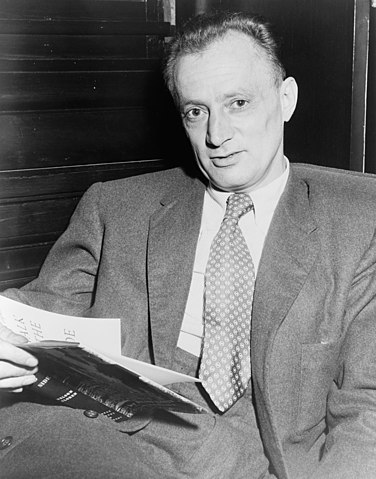
Nelson Algren
Ross, a former college athlete, knew his way around Chicago’s nightclubs - a skill that earned him the job of escorting Benjamin Botkin, the Project’s national folklore director and a jazz fan, around clubs on the city’s South Side during his visit to Chicago. Botkin was thrilled to hear such wonderful music, and later gave Ross the task of interviewing the older Chicago jazzmen for their life stories. They included Muggsy Spanier, Richard Voynow (who had managed the legendary Bix Beiderbecke) and clarinetist Bud Jacobson. Ross would go listen to the musicians play and talk with them afterward.
Through the life stories he gathered came a little-known picture of how segregation affected musicians. Despite the rules, styles crossed the color line and white musicians learned from African American musicians like Coleman Hawkins. “Hawkins was the guy,” Jacobson said. “Up till then nobody knew what to do with the sax in the orchestra.”
In the 1920s, jazz musicians had to abide racial segregation enforced by union rules. Some, like Spanier, learned by getting around those rules. Spanier started as a teenager on drums and switched to cornet, he told Ross, inspired by Joe "King" Oliver, who let a young Spanier sit in with his band. “That was unheard of in those days up North here, a white person playing with Negroes,” Spanier said. “I learned how to play from listening to Joe Oliver…”
In his Chicago interviews, Ross documented a firsthand history of jazz while it was still young, and felt lucky for the chance to hone his storytelling skills at the same time. He later wrote scripts in Hollywood. “I learned my dramatic craft there,” he told Banks for First-Person America.
Notes from a 1939 staff meeting of the Chicago’s folklore group give us a glimpse into how what we now call oral history was changing even then. Botkin had people like them gathering thousands of life histories across the country, and in his way was radically taking folklore out of the halls of academia. As Chicago folklore supervisor, Nelson Algren announced a new tack in collecting industrial folklore, saying that headquarters was planning a volume of urban stories along the lines of the just-published These Are Our Lives. Algren was excited by a new style of documenting urban stories that allowed for even more direct quotations, more direct expression of character from the people themselves. He held up a recent example that Ross read aloud. The examples “reveal a new way of writing,” Algren said, “which we'll attempt here.”
They debated the role of the interviewer, and whether the aim should be a narrative that readers find engaging, or one driven by the interviewee, which might uncover a potentially “truer” and more surprising story than the interviewer could anticipate.
Margaret Walker
Algren, who would later win the first National Book Award for a novel loaded with Chicago voice, was clear about his preference: “Sometime if you just let them ramble, they might say more than if they feel you've got an idea” about what you want to hear. Margaret Walker agreed: “If they have [your] one thing in their mind,” she said, “they'll just go back to it and keep repeating it.” Walker, too, would later hone her storytelling based on what she learned there. The focus was taking contemporary folklore into modern storytelling, a long way from the traditional tall tale prized by academic folklorists of the time.
At the Library of Congress event on May 15, Banks and Virginia Millington from StoryCorps will help put these innovations in storytelling from 75 years ago in the context of stories we hear today. Please come join us. It's free!
This month we marked the Ralph Ellison centennial, celebrating the author of Invisible Man, which won the National Book Award in 1953. Although he became famous as a writer, as a young man Ellison didn’t know that writing would be his path. Growing up in segregated Oklahoma City, he idolized Duke Ellington and planned to become a musician. Ellison studied music at Tuskegee, but before he graduated his family finances crunched and there was no longer enough to pay tuition. Instead he rode the rails north to New York City, where he met Richard Wright. When he was 23, Ellison had to rush to Ohio where his mother was dying. “I lost my mother the day after I arrived,” he wrote to Wright. “This is real, and the most final thing I’ve ever encountered.” By the spring of 1939, Ellison was back in the city with a job documenting life histories for the Federal Writers’ Project. As Soul of a People recounts, he approached people on the streets and asked them about their lives. Ellison was gaining a sense of African American history as he interviewed Harlem residents for the WPA folklore division. He talked with Pullman porters, unemployed truck drivers, musicians, and children. One day at the corner of 135th Street and Lenox, he met a gifted storyteller from South Carolina named Leo Gurley, who told a story about the only man in that town who could escape the oppression of Jim Crow – by becoming invisible. “He was one sucker who didn't give a damn about the crackers,” Gurley said of the man (“I done forgot his real name”) who used a spell to make himself invisible and take what he needed to survive. Other days, Ellison interviewed a drummer about his gigs and audiences, or an older man about why he came to New York. These stories formed a mosaic of a migration larger than anyone had previously imagined. Nationwide the life history interviews documented the lives of ordinary Americans and shared their voices in the public domain on a scale that had never been seen before. This spring marks the 75th anniversary of a group of those life histories gathered by the Writers’ Project. Titled These Are Our Lives, the book assembled stories gathered in the South from people who were black and white, poor and better off, rural and urban. The editor W.T. Couch presented the stories as “written from the standpoint of the individual.” There’s room to dispute that – WPA interviewers often started from a list of set questions, managed the writing, with the final text edited by Couch. Yet the effort marked a step toward people telling their own stories in their own words. On another channel – or another frequency – the voices of life history interviewees percolated through American literature and arts for decades, through talents like Ellison. Historian Jerrold Hirsch notes that the closing of Invisible Man echoes with Ellison’s awareness of that collaboration: “Who knows but that, on the lower frequencies, I speak for you?"
On May 15 we will celebrate life histories and These Are Our Lives with an event at the Library of Congress, where the WPA life history manuscripts are collected along with the archive of a counterpart today, StoryCorps. I look forward to that, bringing together those 1939 voices and the storytelling that they inspired. If you're near D.C., mark your calendar and come.
Early in 1939 Harry Partch, the hobo son of missionaries, arrived in California and signed on to the California Writers’ Project for a second time. As a writer he had a distinctive style and an eye for detail, but even more, he had music. Partch the composer would become one of the most distinctive voices in modern music. At the time, the ancient Chinese poet Li Po inspired him to take a viola and adapt it to a new microtonal scale. Partch would go on to adapt and invent instruments like the Chromelodeon and the Boo II that still inspire performers today. For surviving, though, he turned to writing for the WPA. Two years before, he had worked on the Writers’ Project in California, editing and writing until he grew restless to move again. “Life is too precious to spend it with important people,” he said later in life. He found hoboes and the people he met on the road more open-minded.
The Boo II
“The bums’ courage in remaining stoically humorous in the face of even the gravest misfortune was a value Partch treasured,” noted his biographer Bob Gilmore. The composer’s second stint with the WPA was more agreeable, it seemed. At least he stayed with it longer -- through the publication of the WPA Guide to California that spring and on through the end of the year. Then it was back on the rails, later immortalized in U.S. Highball. Not long ago my old English professor, J. Gill Holland, a polymath who has translated Li Po and other Chinese poets, was delighted to find this video of Partch’s musical adaptation, '17 Lyrics of Li Po.' Holland has published a short piece about his own use of Li Po’s quatrains in creative writing classes in the online journal Enter Text, where he notes that “class presentation of lovely poems like these is always full of amazement and delight, and the notion of a dialogue with past poets is true to Chinese literary tradition.” Just last month, that Li Po/Partch combination inspired songs in The Third Life of King Lear, performed in Brooklyn. The dialogues continue.
This winter brings Broadway and Hollywood versions of strong 1920s women up against hard choices in a hard world: Machinal on Broadway and The Immigrant, which sparked huge enthusiasm at Cannes. Anzia Yezierska lived those choices, growing up on the Lower East Side and making her way from Old World tradition to Hollywood modernity. My guest post on Ken Ackerman’s Viral History explores Yezierska’s experience in light of new productions. Thanks to Ken Ackerman for that opportunity.
See also Part 2, about Yezierska's legacy for those who came after, including the late Grace Paley and Amy Bloom, author of Away and other wonderful books.
Inside Llewyn Davis, the new Coen Brothers film, inhabits a richly evocative time. Just glimpsing the sidewalks of Greenwich Village in the trailer delivers a visual madeleine of New York in the early 1960s.
The Coens infuse that setting with violence, romance and suspense. And while egos and aggression certainly tumbled in the folk music scene with idealism and pettiness, you rarely found such overt conflict all in a single story. Except maybe in the story of one folkie producer and the blues legend he found on a trip that took him far from the Village.
Sam Charters was a young contributor to Folkways Records, the little record label that pioneered folk and blues recording with Woody Guthrie, Lead Belly and Pete Seeger. And Sam “Lightning” Hopkins was a Texas bluesman with roots stretching back to playing with Blind Lemon Jefferson. As Charters wrote later - and as he tells in the documentary I made with Andrea Kalin, Worlds of Sound: The Ballad of Folkways - he hunted the South for Hopkins, who had dropped out of public view. It was a search with its own layers of Coenesque indirection and reversal:
He had almost stopped playing in the late 1950s, and it was difficult to know where to find him. A cousin was working as a cook at a restaurant in New Orleans where I ate, and he told me to look for Lightning in Houston. At first all I could find was Lightning’s guitar. It was in a pawn shop on Dowling Street. The taxi drivers I asked, even Lightning’s sister and his landlady, were carefully vague when I asked where he was. But the word was passing, and the next morning a car pulled up beside mine at a red light, and a thin-faced man wearing dark glasses rolled down the window and called out, “You looking for me?” Lightning had found me.
The episode shows the unwitting hunger of the music subculture and its re-creation of Hopkins from one type of musician into another.
First, Charters “got him a guitar and some gin and managed to convince him that I was serious about doing a session with him.” They recorded on January 16, 1959 in the small, dingy room that Hopkins rented. Charters insisted that Hopkins play an acoustic guitar, not the electric of his earlier recordings. Charters also paid up front, with no prospect for royalties.
One of the songs they recorded that session was “See that My Grave is Kept Clean” – done by Blind Lemon 31 years before. (Decades later B.B. King recorded his own version, showing once again the power of the blues to conjure life in the midst of death or vice versa.)
The Houston neighborhood where Charters recorded Hopkins held its own violent pall, of Jim Crow, which Hopkins did his best to ignore. But as an episode on page 95 in his biography, Mojo Hand: The Life and Music of Lightnin’ Hopkins,
makes clear, he couldn’t always keep it out. Even after his career rose in the 1960s, a bartender at Zito’s Jungle Hut in Houston’s Third
Ward denied him service for being black. Grover Lewis, a
journalist who shadowed the musician, described it in the Village Voice:
When Hopkins approached the bar and ordered, the waiter answered tonelessly, “We all outta beer today, man.” Looking steadily at me, the barman mumbled, “I told you fellow, we ain’t got no beer today.”…. Stunned, Hopkins spun around and motioned curtly for me to follow, plunged back out into the sunlight. … he tried to dismiss the incident as a joke, but the more he talked about it, the angrier he became. The episode seemed to trigger some edginess in him, and in the moments that followed, he grew increasingly morose…
Folkways released the album Charters recorded later in 1959 around the time that the book The Country Blues came out. Lightnin’ Hopkins was finding himself repackaged for a new, whiter audience. Mojo Hand traces that transformation:
Before The Score label issued Lightnin’ Hopkins Strums the Blues in 1958, a compilation of previous releases from 1946 - 48. The jacket showed a white arm strumming. “Apparently, the decision-makers at Score Records thought revealing Hopkins to be an African American was not wise. The unsigned liner notes, just two paragraphs, barely hinted at his race and clearly positioned Hopkins as a true folkie… Like great folk artists such as Burl Ives, Lightnin’ improvised easily; the Score liner notes assert: ‘A chance sunlight – a glimpse of a railroad – the play of moon on the water, all turn his talent into a quick, fluent outpouring of feeling in wonderful accompaniment to his rich guitar. So long as folk music endures so long will Lightnin’ Hopkins be played.’
The labels were aiming at me. My first encounter with a Lightnin’ Hopkins record was as a white teenage suburbanite, and because his voice and his guitar playing appealed to my desire for music that was bracing but not forbidding, I bought his album.
That included “Big Black Cadillac Blues,” a tale of seduction, betrayal and suspense that even has its own car chase, where the singer finally catches up to where his lover has stolen the prized machine of the title, but too late – she had already ruined it. “It wouldn’t run for me," he sighs, "and it wouldn’t run for you.” (This version includes the whole story intro.)
The year after the Folkways record came out, Hopkins had a ticket for gigs out West and an invitation to New York City. Mojo Hand again:
After his stint along the West Coast, Hopkins headed to New York City … New York promoter Harold Leventhal … arranged for Hopkins to play Carnegie Hall on October 14, 1960, for a benefit for the folk music magazine Sing Out! The bill contained several important folk artists of the day, including the renowned Pete Seeger, the Clancy Brothers, Tommy Makem, Elizabeth Knight, Jerry Silverman, the Harvesters, and nineteen-year-old Joan Baez.
The New York Times gave much of its review of the concert to Hopkins, praising his “wit and flair and improvisatory skill.” He swapped verses with Pete Seeger and had taken, the Times reviewer noted, a long journey from Houston’s Third Ward to Carnegie Hall.
Bob Dylan would make his own hometown-to-Manhattan venture a few months later, in January 1961. And of course he was repackaging himself.
This fall Baez returned to the Carnegie Hall stage for an Inside Llewyn Davis concert, where Jack White sang a song that Lightnin’ Hopkins had recorded first.
The folk music movement shrink-wrapped many musicians to reach a mainstream white audience. At the same time, for many American listeners it opened a window to cultural alternatives. “Folkways,” says Charters in Worlds of Sound, “presented an alternative that was life sustaining, life giving…. we were showing that there was an alternative. Not by simply attacking what was there but saying, ‘Hey what about this? We know this but why not that too?’”
The other week marked a rare event: the Library of Congress and the Folger Shakespeare Library – two of the country’s most venerable institutions – noted that our city has a lively, bubbling book scene. Organized by PEN/Faulkner, the event, called District of Literature, took place on the eve of the federal shutdown. After a reception at the Folger where small press authors chatted with notable officials of the word, I crossed the street to the Lutheran Church of the Reformation, and joined fellow Washington Writers’ Publishing House author Brandel France de Bravo in the audience. To my left in our pew, bestselling authors Elliott Holt and Danielle Evans huddled. And to our right, after her duties as emcee, Emma Snyder of PEN/Faulkner took a seat. A few rows ahead I saw Sunil Freeman of The Writer’s Center. Poets, fictionistas, authors of histories – all found a seat under this roof. The four readers that night laid out a rich banquet of life and death found in the city, from Elizabeth Alexander’s poetry – encompassing a girl’s early anxieties, Stokely Carmichael's public confab with A. Philip Randolph, and even the outsider vision of James Hampton’s Throne, from its garage near Seventh Street to its current home at the American Art Museum – to Edward P. Jones’ Hurston-esque story, ‘The Devil Swims Across the Anacostia River.’ And from E. Ethelbert Miller’s poems of life and everyday struggle on the streets to George Pelecanos’ tale of mortality in The Night Gardener, based loosely on the Freeway Phantom who terrorized Washington in the early 1970s. By the time we spread out into the night, with the Capitol’s lighted wedding cake just blocks away, I felt full from a shared feast. You find guideposts to many of these offerings in DC By the Book, a website connecting fiction to the city’s landscape created by the DC Public Library, which has always nurtured local writers and readers. And you can find your own place here, whether in fiction, poetry or nonfiction. One way to do that is with a Writer’s Center workshop - including mine this Saturday, Putting the Pieces Together: Researching and Writing Local History. Whatever you choose, I hope we get to read your stuff soon.
Thanks to Sunil Freeman at The Writer's Center for featuring my post about writing neighborhood histories -- with examples involving Harlem (from Village Voice) and Meridian Hill (from the Washington Post Magazine) -- on First Person Plural, the Center's blog.
Check out the workshops that start this fall!
Thanks to Bill Doughty for his glowing review of The War of 1812 and the Rise of the U.S. Navy on this blog here. Of course I agree the book is "gorgeous" -- but all credit goes to the book's designers, led by Carrie Hamilton. I also appreciate Doughty's timely focus on the book's rendering of the events leading up to the Battle of Lake Erie, two hundred years ago this month.
Events this month on the Great Lakes make those chaotic times vivid and alive. Check the schedule here, and enjoy a simmering August.
For the bookTall Ship Odysseys, about a few people from the great ships
and their experiences across five decades, I met with Jarle Flatebø, captain of
theStatsraad Lehmkuhl. This post is adapted from that visit. Later this week
the ship sails across the Baltic from Denmark to Helsinki. Next month another Norwegian sailing ship, the Sorlandet, will be at Chicago's Navy Pier as part of the Tall Ships America tour of the Great Lakes.
Rain falls in Baltimore as the Statsraad
Lehmkuhl prepares to return across the Atlantic to her home of Bergen, Norway.
At 18:00 that evening she will set out, led by a pilot for 16 hours down the
Chesapeake Bay, then head out to the open sea. With a top speed of 18 knots and
2,000 square meters of sail, the ocean crossing takes exactly 3 weeks, under
sail power for almost the whole voyage.
The ship is a mighty three-masted barque, built
as a German training ship and launched in Bremen in 1914, on the eve of World
War I. Originally named Grossherzog Friedrich August, she trained German
sailors throughout the war. On Germany’s defeat in 1918, a British ship took
her as a prize of war and in 1921 she was bought by ship agents in Bergen and
renamed for her new owner to immortalize his title of cabinet minister
("statsraad"). By the time I walked her deck with the captain, she
had trained sailors from many generations and nations.
After nearly a century the Statsraad Lehmkuhl
plies the sea with a renewed mission as the sail-training vessel for Norway’s
navy and merchant marine service. At over 321 feet long, she’s the largest
three-masted barque on the sea today. When I saw her in Baltimore, she had 62
cadets on board. She can handle up to 150 with 18 professional crew members,
most of them merchant mariners.
Captain Jarle Flatebø started as a merchant
navy cadet in 1972, and fell in love with tall ships. Standing on the deck, he
says, he feels “an unbroken line back to the Viking ships.” He came from a
sea-going family in the islands off Norway’s western coast. They moved to Oslo
when he was a boy but he never adapted well to life in the city. Now he spends
six to eight months a year at sea – four months on the Statsraad, and the
winter months at the helm of ocean cruise ships down the African coast.
Capt. Flatebø guides me through the ship: up
the aft steps to the wheelroom, outfitted with laptops and flat screen
monitors. A step to the deck, and I’m again in the 1800s. The rigging hangs in
the damp breeze. The forward decks hold the galley and crew’s quarters: one per
cabin in the foremost officers’ quarters, and a big dorm-like mess that doubles
as sleeping quarters for cadets, with hooks in the white-painted I-beams from
the ceiling for hammocks, and lockers for personal belongings. In the mess,
crew members are taking their meal.
For merchant navy sailors, practical seamanship
is a major incentive for joining a sail ship. For the Norwegian navy, the
motive is teambuilding, testing at sea, and skills practice in isolation. The Statsraad
takes first-year cadets in the fall and works them for three months until the
return to Bergen.
In heavy weather they use only three or four
sails but drills continue, including man-overboard rescues, which they do day
or night. The cadets set rubber rafts into the dark water and must within three
minutes pull away from the ship, return, and employ CPR and other first-aid.
The bosun, a handsome Dane with ponytail and a
gold earring, says he lets the cadets fail as much as possible to better learn.
In his opinion, the crew compresses three or four years of learning into three
months. (The bosun also takes pride in having refitted much of the ship with
PVC rigging, which looks exactly like hemp but is more resilient. With stronger
materials, they can sail the ship with a leaner crew.)
When I ask about competitiveness among the
Norwegians, Danes and Swedes on the crew, the bosun insists there isn’t any.
But he adds with a smile – outside earshot of the captain -- that he and two
other Danes say that the deck belongs to them.
Jan Miles started as an interim captain with the Pride I in 1981, having worked as a mate on large sailing vessels for nine years. He had a fascination with Baltimore clippers and their origins in the China trade of the 1700s and early 1800s. In those days, the ships that set out from Philadelphia, Boston and New York heading for Asia were paradoxically smaller than those in the Europe trade. Going to Asia, ships couldn't rely on protection from a flag. The American response to the risks was to use small, high-value cargo (starting with ginseng) and focus on speed and agility.
In 1986 tragedy struck the Pride I and in the years after it sank, its successor started a Christa McCullough fellowship, honoring the teacher who died in the tragedy. That's how Miles would later meet his wife, a teacher who held the fellowship in 1998.
In 1992 when an international gathering of ships was planned for Puerto Rico, there was lots of discussion about whether to participate. Ultimately, the Pride II set sail that summer for Puerto Rico via Bermuda to join the transatlantic fleet coming from Las Palmas.
Miles had a few misgivings. "This was the first big fleet since 1986," he said. "There was passion involved. Puerto Rico has a particular draw" for northern sailors. "There was a sense of anticipation."
As they neared the island, the crew’s excitement peaked. "To our south we could see Puerto Rico’s mountains capturing some low-level rain clouds."
They could also see the big square-riggers coming in. "We were in the front row of a very nice balcony," he recalled. "The various blues and grays that come with dusk," and darker tones below that with the rain clouds. Then the next day, the harbor was a forest of masts.
The time passed quickly and in the departure from San Juan, the goodbyes with fellow sailors moved by the Pride’s return were bittersweet. The parade of sail set out spectacularly on the north coast. "What a majestic thing that was! Everyone was piling on the canvas" and going faster than the 6-knot goal, Miles said. “There was a tremendous opportunity for a panorama of the whole fleet."
They watched Puerto Rico slide beneath the horizon. For a full day, they headed north surrounded by a "host of sailing vessels."
"That whole movie, as I play it in my head," Miles recalls, is filled with ships and crews that he knew, and they knew the Pride. "I'm busy sailing the boat, but distracted the whole time. I knew those vessels.” He pointed them out to his crew like family snapshots. Maybe European crews were more used to gathering every year or two, but for an American this was a rare treat.
The ships began to peel off for stops in various ports on the way to New York. "We were seeing lights well into the evening," he says. Then they twinkled out. "Come the next day, we weren’t seeing much."
"The ocean’s a pretty big place."
See also my post about a tour on the Pride II with its crew on the National Geographic Intelligent Travel blog.
This spring sees the publication of On the Ropes, a long-awaited sequel to James Vance’s earlier graphic novel, Kings in Disguise, which followed the hard journey of teenage Freddie Bloch. When Freddie’s father loses his job in the Great Depression, Freddie goes from being a nice Jewish kid to the life of a hard-luck hobo, one of nearly a quarter million other homeless youth, riding the rails. He meets Sam, who claims to be the “King of Spain” and together they find themselves in some of the landmark moments of the Great Depression – including the 1932 Ford Hunger Strike of unemployed workers at the River Rouge plant in Michigan. By the end of Kings in Disguise, Freddie has helped an ailing Sam return to his hometown, and embarked on another journey solo, now sure that his mission in life is the cause of organizing the poor and giving voice to the common man. On the Ropes finds Freddie in 1937, a few years after leaving Sam. He’s still on the road, but now working in a circus funded by the Works Progress Administration, or WPA. The action takes place in a few months’ time but, as Vance said in a recent interview with Oklahoma magazine, historically “this two-month period… was incredibly full of events.” Another Oklahoman published a real-life thriller with a hobo protagonist in 1935. Jim Thompson, later famous for pulp novels like The Grifters and silver-screen collaborations with Stanley Kubrick, wrote "The Strange Death of Eugene Kling," a detective story for True Detective magazine. Thompson, son of a deputy sheriff who hit hard times, grew up in the shadow world of Oklahoma and for a while in the mid-1930s eked out a living as a true-crime writer. In "Eugene Kling," Thompson records the true story of Robert Norwood, a young hobo in Oklahoma. When his friend is found murdered, Norwood sets out to solve the mystery and bring the killer to justice. That (as recapped in Soul of a People) involves gathering evidence in homeless shelters and tracking down suspects by hopping a freight. Thompson used all the storytelling devices at his disposal – what he called his "little bag of tricks" – and made the hobo detective’s tale not only a gripping read but a window into the lives of the homeless. "The Strange Death of Eugene Kling" was both unsparing in its view of human nature and sensitive in its portrayal of young Norwood's trials: the loneliness, hard landings, privations, and hopes for a stable life. When writing crime stories failed to pay the bills, Thompson joined the Works Progress Administration, just like Freddie Bloch. Except Thompson joined the Federal Writers’ Project, and went on the road to document Oklahoma life for the American Guide series, known as the WPA guides. It was hard work for low pay but like Bloch, Thompson came to see it as a sort of mission, working his way up to editor before leaving in frustration. To honor him and Vance’s characters, here’s the full story of "The Strange Death of Eugene Kling," with pictures, as it appeared in November 1935.
Author of Soul of a People: The WPA Writers' Project Uncovers Depression America and writer and co-producer of the Smithsonian documentary, Soul of a People: Writing America's Story. Co-author of The War of 1812 and the Rise of the U.S. Navy. I lead workshops at The Writer's Center in Bethesda, MD. www.davidataylor.com




 Posts
Posts


