Showing posts with label oral history. Show all posts
Showing posts with label oral history. Show all posts
Monday, May 12, 2014
Inquiring Minds in the Library of Congress
My thanks to Erin Allen and the staff at the Library of Congress for featuring this Q&A about the Federal Writers' Project and the event at the Library showcasing the WPA writers' legacy in oral history with the 75th anniversary of the publication of These Are Our Lives, which first appeared in May 1939.
The event features Ann Banks, author of First-Person America (now available on Kindle), Virginia Millington from StoryCorps, and actors John Stange and Eternanda Fudge, courtesy of DC's Theatre Lab, evoking the WPA life histories from These Are Our Lives. Please read and let us know what you think. And watch for the webcast of the May 15 event at the Library of Congress, coming soon. Details here.

Friday, April 25, 2014
When Oral History Changed Storytelling
Every week on NPR you might hear pieces from StoryCorps. Nearly as often you might catch firsthand glimpses of history in "oral histories" without knowing what that term means. The Library of Congress connects some of these dots with an event on May 15 in its "Beyond the Book" series. The event marks the 75th anniversary of These Are Our Lives, a ground-breaking collection of life histories, what would today be called oral histories, produced by the government but intended to reflect the most individual elements of American life, from some of its most unsung citizens.
 While researching my book on the Federal Writers’ Project, I learned of the nationwide effort to gather these histories (These Are Our Lives contains stories from the South but there are thousands more) from Ann Banks, author of First-Person America. Her book delivers more selections from that rich oral history material gathered by the Project, which she found gathering dust in the Library of Congress 40 years ago.
While researching my book on the Federal Writers’ Project, I learned of the nationwide effort to gather these histories (These Are Our Lives contains stories from the South but there are thousands more) from Ann Banks, author of First-Person America. Her book delivers more selections from that rich oral history material gathered by the Project, which she found gathering dust in the Library of Congress 40 years ago.Banks was suggested to me by one of the Project’s famous survivors, Studs Terkel, who championed oral history in many forms – from radio interview to his own books (which sometimes morphed into other forms like the musical Working) -- as a way to get history from real people.
In 1939 Terkel was working in the Project’s radio division, where he researched and wrote profiles for a weekly one-hour broadcast. He wasn’t doing oral history, as he admitted; his job was to write scripts about artists like Daumier, Van Gogh, Eakins, and George Bellows. But he absorbed the Project’s ethos of getting people’s stories to the public. Sometimes Terkel slipped out back with Nelson Algren, one of the life history interviewers, to a nearby bowling alley.
Sam Ross, who worked with Terkel in the radio division but also conducted life history interviews, summed up the atmosphere later: “Everybody felt alive,” Ross said. “We were linked to the community.”
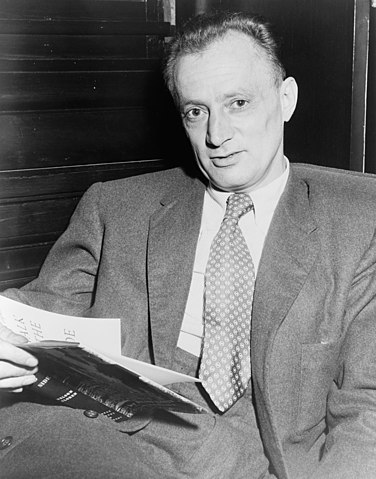 |
| Nelson Algren |
Through the life stories he gathered came a little-known picture of how segregation affected musicians. Despite the rules, styles crossed the color line and white musicians learned from African American musicians like Coleman Hawkins. “Hawkins was the guy,” Jacobson said. “Up till then nobody knew what to do with the sax in the orchestra.”
In the 1920s, jazz musicians had to abide racial segregation enforced by union rules. Some, like Spanier, learned by getting around those rules. Spanier started as a teenager on drums and switched to cornet, he told Ross, inspired by Joe "King" Oliver, who let a young Spanier sit in with his band. “That was unheard of in those days up North here, a white person playing with Negroes,” Spanier said. “I learned how to play from listening to Joe Oliver…”
In his Chicago interviews, Ross documented a firsthand history of jazz while it was still young, and felt lucky for the chance to hone his storytelling skills at the same time. He later wrote scripts in Hollywood. “I learned my dramatic craft there,” he told Banks for First-Person America.
Notes from a 1939 staff meeting of the Chicago’s folklore group give us a glimpse into how what we now call oral history was changing even then. Botkin had people like them gathering thousands of life histories across the country, and in his way was radically taking folklore out of the halls of academia. As Chicago folklore supervisor, Nelson Algren announced a new tack in collecting industrial folklore, saying that headquarters was planning a volume of urban stories along the lines of the just-published These Are Our Lives. Algren was excited by a new style of documenting urban stories that allowed for even more direct quotations, more direct expression of character from the people themselves. He held up a recent example that Ross read aloud. The examples “reveal a new way of writing,” Algren said, “which we'll attempt here.”
They debated the role of the interviewer, and whether the aim should be a narrative that readers find engaging, or one driven by the interviewee, which might uncover a potentially “truer” and more surprising story than the interviewer could anticipate.
 |
| Margaret Walker |
Margaret Walker agreed: “If they have [your] one thing in their mind,” she said, “they'll just go back to it and keep repeating it.” Walker, too, would later hone her storytelling based on what she learned there. The focus was taking contemporary folklore into modern storytelling, a long way from the traditional tall tale prized by academic folklorists of the time.
At the Library of Congress event on May 15, Banks and Virginia Millington from StoryCorps will help put these innovations in storytelling from 75 years ago in the context of stories we hear today. Please come join us. It's free!
Friday, October 7, 2011
Voices of Frustration
Well, things change in a week. The protest on Wall Street has gathered momentum in cities across the country. In TheRoot today, Chris Jenkins lets four skilled black professionals in DC speak for themselves on the frustrations of finding work now, in words that crystallize the protesters' concerns often better than the Occupiers themselves. Tyrone Jackson, an electrician, gives powerful expression to that experience and the lengths he's gone to -- hours back and forth between the city and Spotsylvania County, Virginia -- to find work.
"You could build a house with a foundation with the types of people I know who have skills out here and can't find jobs," he says.
Jenkins does right by Jackson and by the tradition of oral history.
"You could build a house with a foundation with the types of people I know who have skills out here and can't find jobs," he says.
Jenkins does right by Jackson and by the tradition of oral history.
Wednesday, September 29, 2010
A Man Named L'Amour
Louis L'Amour, one of the bestselling writers of Westerns in history, started out writing for the WPA guide to Oklahoma under the direction of noir novelist Jim Thompson. Born Louis LaMoore in North Dakota, he regaled other WPA staff with tales from travels to Africa and Asia. He helped organize a Southwest Writers’ Conference in May 1937 and often visited the Thompsons’ house for dinner. Over time, Thompson tired of LaMoore’s tall tales. In L'Amour's memoir An Education of a Wandering Man , he wrote,
Tomorrow night in L'Amour's beloved West, the Colorado Springs Arts Center will show Soul of a People: Writing America's Story .
.
, he wrote,Somehow he left out mention of his time working on the WPA. But L'Amour did note that the Writers' Project "sent out people to interview old-timers and gather what material they could... The interviews vary in quality, but some are excellent and most contain information important to history."At the time I settled down in Oklahoma to become a writer or else, the short story was the thing. There were many magazines publishing short stories... However, they paid very little, and the number of people who could write quality stories... far exceeded the market... I had to make a living from my writing, and that meant work and lots of it.
Tomorrow night in L'Amour's beloved West, the Colorado Springs Arts Center will show Soul of a People: Writing America's Story
.
Thursday, September 2, 2010
Coming to America Stories - Free for a few days
There's nothing like hearing it from the horse's mouth. Listen to Lawrence Meinwald relive the emotional charge he felt seeing the Statue of Liberty for the first time in 1920, or hear Millvina Dean, last living survivor of the Titanic.
For a few days -- until Monday, September 6, reports the Times -- you can listen for free to stories from oral histories recorded with people who immigrated to the U.S. through Ellis Island. Recorded by the National Park Service, the recordings have up to now been accessible only if you went to the Ellis Island park.
For a few days -- until Monday, September 6, reports the Times -- you can listen for free to stories from oral histories recorded with people who immigrated to the U.S. through Ellis Island. Recorded by the National Park Service, the recordings have up to now been accessible only if you went to the Ellis Island park.
Friday, August 13, 2010
Adventures in Animating Real Stories

It helps if you have broadcast-quality voices from the original storyteller, as in the StoryCorps case, but the WPA Life Histories online hold gems that would work well as animated shorts too.
Try this: Find 2 or 3 vivid episodes in a life history (maybe in your home state, or not) and imagine a two-minute video for one of them.
Wednesday, June 3, 2009
Grassroots history
Not long ago I was in Richmond, VA to tape an interview with Liz Humes at WRIR and a talk about the Writers' Project at the Fountain Bookstore. A lot of good questions, which you'll get to hear when Book TV broadcasts the session sometime soon.
For now just two: One questioner drew the link between the Writers' Project and the recordings of folk songs and lore that came later, such as Harry Smith's Anthology of American Folk Music, issued by Folkways in the 1950s. Another asked how a comparable attempt today at getting local history and people's stories might get started. Libraries and their patrons -- and the discussions and events this summer and fall -- could be a good start. Many will include local historians talking about grassroots histories, and helping people record oral histories.
This Friday we head to North Carolina for a talk on WUNC's The State of Things and a gathering at Quail Ridge Books in Raleigh. See you there.
Subscribe to:
Posts (Atom)


 Posts
Posts


