Tuesday, June 28, 2011

School Libraries Under Fire


My early memories of reading take me back to the library at Washington Mill Elementary, where in third or fourth grade I spent hours poring over a series of biographies along with occasional scifi like A Wrinkle in Time. That was where I caught my appetite for life stories, one that nourishes me still – both intangibly and with food on the table.
    So it hurts to read that school districts across the country are eliminating libraries and librarian positions. In Oregon, all 48 librarians in the Salem-Keizer school district’s elementary and middle schools face layoffs in a budget that will be voted on this week.
    True, more classrooms are using laptops and iPads so students can do research without going to the library, but libraries are still where kids can learn skills they need to use those tools and analyze their searches and results, says Nancy Everhart, who leads a national association of school librarians, in the New York Times. In libraries they can find interests they might not otherwise see.

Wednesday, June 15, 2011

Three Writers Tackle History

Last Saturday at the AIW Writers' Conference held at The Writer's Center, a trio of fine authors -- Barbara Esstman, C.M. Mayo and Natalie Wexler -- surrounded the challenges and opportunities of historical fiction from three sides. Here are C.M. Mayo's insights (plus a fine reading list for any writer) on her blog after the event.

Friday, June 10, 2011

Footsteps at Night: 1930s California

Los Angeles in the 1930s: The WPA Guide to the City of Angels (WPA Guides)Okay, forgive me first for pointing out Library Journal's glowing review of Soul of a People. They call it a “touching, straightforward, and well-paced look” at this slice of American history, “a welcome addition to literature and history collections.” My partners on the film and I couldn’t agree more.
    Just in the last two months come two reprints of WPA guides, with insightful new introductions by David Kipen: the WPA Guide to Los Angeles, with an essay that points out the bubbling L.A. scene when the book was first written, with early film noir and Orson Welles, and late F. Scott Fitzgerald. Southern California was even more beautiful than now, and a magnet for fascinating people. “If only some benevolent patron had stepped in and commissioned a panorama of prewar Los Angeles,” Kipen writes. “In other words, if only there existed the book that you … now hold in your hand.” He is as lavish with San Francisco, where he lived for years.
    This is how the stories and footsteps of the past stay with us. As I come from burying my father this week, this is on my mind: mixing stories with histories.

Thursday, May 26, 2011

Amadou and Mariam: Storytellers for Change 3

The other week I had the great opportunity to speak with the Malian duo Amadou and Mariam as they headed to China on their concert tour. The two just published a memoir, titled Away from the Light of Day, recorded a new CD, and are planning another exciting series of concerts.
    Read what they have to say about their memoir, and changes in the lives of Malian musicians today, on Afropop Worldwide's site.

Monday, April 25, 2011

Music Against Malaria: Storytellers for Change 2

For World Malaria Day, here’s my conversation with Yacine Djibo, country director for Malaria No More, from my recent trip to Senegal.
    There as in Mali, the campaign to fight malaria highlights musicians committed to wiping the scourge from the countryside. In Dakar, Djibo described their intensive campaign to “surround malaria.” It involves Youssou NDour, catchy melodies, and an American Idol-style national contest. Watch the spot that appears every night on Senegalese TV.
    Djibo says their campaign also offers a starting point for early diagnosis and better prevention with antimalarial drugs. Senegal’s cases of malaria have declined steeply in two years, according to this recent report by Roll Back Malaria.

Tuesday, March 29, 2011

Storytellers as Change Agents in West Africa?


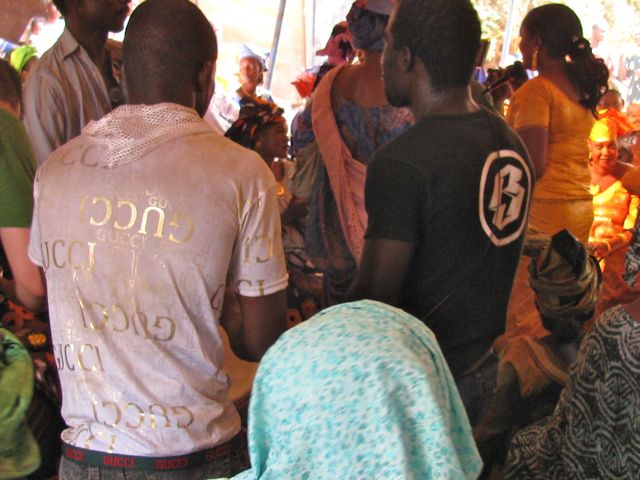
In Bamako on Sunday, I got to a wedding event (they spread through the weekend) where the families gathered and griots sang their praises. Griot is sometimes translated as "storyteller," and as a caste they have a fascinating and precarious place in Mali society and across West Africa: they traditionally depend on the patronage of wealthy families whose stories they sing at events, but they also sometimes speak truth to power.
    In this photo the female griot at right sings praises to the accompaniment of the djembe drummers in the foreground.
In Griot Time    Banning Eyre's book, In Griot Time, is a fun way into his story of learning Malian guitar from griots.
    In a growing global push against malaria, some health advocacy campaigns in Mali have enlisted griots. Recognizing how they have the ear of everyday people and thought leaders, the campaigns invite griots to integrate lyrics about how mosquito nets help protect children from getting malaria into their work. Some griots at the local-level have included that messaging at wedding gigs.

Monday, March 21, 2011

Now for Something Completely Different

Now in West Africa for a month with an IRP reporting fellowship, and just getting my bearings in Mali's capital with a walk through the main market. Two quick and simple observations on the changes since Richard Wright's tour of these countries at independence just over a half century ago:
1) West African fashion is timeless but changes in communication and public relations move at warp speed (I exaggerate). Witness the teeming boys on every corner selling cellphone minutes, and a heightened perception by everyone here of how the world sees images from Africa. They know journalists usually go for the poverty-makes-sympathy shot.
    Twice I framed a photo and got the stink eye. First an older man insisted I pay for the opportunity (he relented when I sounded incredulous about paying a building to take its picture). Then a teenage girl said my shot of people at a railroad crossing was "pas beau" -- not pretty. Both showed a consciousness of putting Mali's best foot forward and not getting exploited.
2) Impressive variety of food in the popular market. Where are they growing cool-weather items like lettuce? Lots of potatoes, garlic, tomatoes, mangoes, beets, peppers, fish of various sizes, and much more. And this is the hot season when wind kicks up dust and the temp spills over 100F.
The billboard for the cellphone and Internet service provider says 'Business is Everywhere.'