Wednesday, July 3, 2013

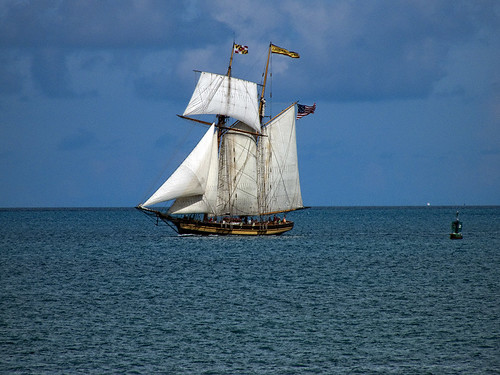
Summer Sails 2: On a Scandinavian Deck in Baltimore Harbor


For the book Tall Ship Odysseys, about a few people from the great ships and their experiences across five decades, I met with Jarle Flatebø, captain of the Statsraad Lehmkuhl. This post is adapted from that visit. Later this week the ship sails across the Baltic from Denmark to Helsinki. Next month another Norwegian sailing ship, the Sorlandet, will be at Chicago's Navy Pier as part of the Tall Ships America tour of the Great Lakes.


Rain falls in Baltimore as the Statsraad Lehmkuhl prepares to return across the Atlantic to her home of Bergen, Norway. At 18:00 that evening she will set out, led by a pilot for 16 hours down the Chesapeake Bay, then head out to the open sea. With a top speed of 18 knots and 2,000 square meters of sail, the ocean crossing takes exactly 3 weeks, under sail power for almost the whole voyage.
    The ship is a mighty three-masted barque, built as a German training ship and launched in Bremen in 1914, on the eve of World War I. Originally named Grossherzog Friedrich August, she trained German sailors throughout the war. On Germany’s defeat in 1918, a British ship took her as a prize of war and in 1921 she was bought by ship agents in Bergen and renamed for her new owner to immortalize his title of cabinet minister ("statsraad"). By the time I walked her deck with the captain, she had trained sailors from many generations and nations.
    After nearly a century the Statsraad Lehmkuhl plies the sea with a renewed mission as the sail-training vessel for Norway’s navy and merchant marine service. At over 321 feet long, she’s the largest three-masted barque on the sea today. When I saw her in Baltimore, she had 62 cadets on board. She can handle up to 150 with 18 professional crew members, most of them merchant mariners.
    Captain Jarle Flatebø started as a merchant navy cadet in 1972, and fell in love with tall ships. Standing on the deck, he says, he feels “an unbroken line back to the Viking ships.” He came from a sea-going family in the islands off Norway’s western coast. They moved to Oslo when he was a boy but he never adapted well to life in the city. Now he spends six to eight months a year at sea – four months on the Statsraad, and the winter months at the helm of ocean cruise ships down the African coast.
    Capt. Flatebø guides me through the ship: up the aft steps to the wheelroom, outfitted with laptops and flat screen monitors. A step to the deck, and I’m again in the 1800s. The rigging hangs in the damp breeze. The forward decks hold the galley and crew’s quarters: one per cabin in the foremost officers’ quarters, and a big dorm-like mess that doubles as sleeping quarters for cadets, with hooks in the white-painted I-beams from the ceiling for hammocks, and lockers for personal belongings. In the mess, crew members are taking their meal.
    For merchant navy sailors, practical seamanship is a major incentive for joining a sail ship. For the Norwegian navy, the motive is teambuilding, testing at sea, and skills practice in isolation. The Statsraad takes first-year cadets in the fall and works them for three months until the return to Bergen.
    In heavy weather they use only three or four sails but drills continue, including man-overboard rescues, which they do day or night. The cadets set rubber rafts into the dark water and must within three minutes pull away from the ship, return, and employ CPR and other first-aid.
    The bosun, a handsome Dane with ponytail and a gold earring, says he lets the cadets fail as much as possible to better learn. In his opinion, the crew compresses three or four years of learning into three months. (The bosun also takes pride in having refitted much of the ship with PVC rigging, which looks exactly like hemp but is more resilient. With stronger materials, they can sail the ship with a leaner crew.)
    When I ask about competitiveness among the Norwegians, Danes and Swedes on the crew, the bosun insists there isn’t any. But he adds with a smile – outside earshot of the captain -- that he and two other Danes say that the deck belongs to them.

Wednesday, June 19, 2013

Tall Ships and Summer Sails

For the book Tall Ship Odysseys, which commemorates a handful of the people and the gatherings of Operation Sail across five decades, I spoke with Jan Miles, captain of the Pride of Baltimore II. This post finds the Pride II on a summer voyage of the Great Lakes. In September the 200th anniversary of the Battle of Lake Erie and Oliver Hazard Perry's victory will be celebrated with eight ships at Put-in-Bay, Ohio.

Aboard a Baltimore clipper

Jan Miles started as an interim captain with the Pride I in 1981, having worked as a mate on large sailing vessels for nine years. He had a fascination with Baltimore clippers and their origins in the China trade of the 1700s and early 1800s. In those days, the ships that set out from Philadelphia, Boston and New York heading for Asia were paradoxically smaller than those in the Europe trade. Going to Asia, ships couldn't rely on protection from a flag. The American response to the risks was to use small, high-value cargo (starting with ginseng) and focus on speed and agility.
    In 1986 tragedy struck the Pride I and in the years after it sank, its successor started a Christa McCullough fellowship, honoring the teacher who died in the tragedy. That's how Miles would later meet his wife, a teacher who held the fellowship in 1998.
    In 1992 when an international gathering of ships was planned for Puerto Rico, there was lots of discussion about whether to participate. Ultimately, the Pride II set sail that summer for Puerto Rico via Bermuda to join the transatlantic fleet coming from Las Palmas.
    Miles had a few misgivings. "This was the first big fleet since 1986," he said. "There was passion involved. Puerto Rico has a particular draw" for northern sailors. "There was a sense of anticipation."
    As they neared the island, the crew’s excitement peaked. "To our south we could see Puerto Rico’s mountains capturing some low-level rain clouds."
    They could also see the big square-riggers coming in. "We were in the front row of a very nice balcony," he recalled. "The various blues and grays that come with dusk," and darker tones below that with the rain clouds. Then the next day, the harbor was a forest of masts.
    The time passed quickly and in the departure from San Juan, the goodbyes with fellow sailors moved by the Pride’s return were bittersweet. The parade of sail set out spectacularly on the north coast. "What a majestic thing that was! Everyone was piling on the canvas" and going faster than the 6-knot goal, Miles said. “There was a tremendous opportunity for a panorama of the whole fleet."
    They watched Puerto Rico slide beneath the horizon. For a full day, they headed north surrounded by a "host of sailing vessels."
    "That whole movie, as I play it in my head," Miles recalls, is filled with ships and crews that he knew, and they knew the Pride. "I'm busy sailing the boat, but distracted the whole time. I knew those vessels.” He pointed them out to his crew like family snapshots. Maybe European crews were more used to gathering every year or two, but for an American this was a rare treat.
    The ships began to peel off for stops in various ports on the way to New York. "We were seeing lights well into the evening," he says. Then they twinkled out. "Come the next day, we weren’t seeing much."
    "The ocean’s a pretty big place."

See also my post about a tour on the Pride II with its crew on the National Geographic Intelligent Travel blog.

Tuesday, June 11, 2013

On the Rails and On the Ropes in Oklahoma


This spring sees the publication of On the Ropes, a long-awaited sequel to James Vance’s earlier graphic novel, Kings in Disguise, which followed the hard journey of teenage Freddie Bloch. When Freddie’s father loses his job in the Great Depression, Freddie goes from being a nice Jewish kid to the life of a hard-luck hobo, one of nearly a quarter million other homeless youth, riding the rails. He meets Sam, who claims to be the “King of Spain” and together they find themselves in some of the landmark moments of the Great Depression – including the 1932 Ford Hunger Strike of unemployed workers at the River Rouge plant in Michigan.
    By the end of Kings in Disguise, Freddie has helped an ailing Sam return to his hometown, and embarked on another journey solo, now sure that his mission in life is the cause of organizing the poor and giving voice to the common man.
   On the Ropes finds Freddie in 1937, a few years after leaving Sam. He’s still on the road, but now working in a circus funded by the Works Progress Administration, or WPA. The action takes place in a few months’ time but, as Vance said in a recent interview with Oklahoma magazine, historically “this two-month period… was incredibly full of events.”
    Another Oklahoman published a real-life thriller with a hobo protagonist in 1935. Jim Thompson, later famous for pulp novels like The Grifters and silver-screen collaborations with Stanley Kubrick, wrote "The Strange Death of Eugene Kling," a detective story for True Detective magazine. Thompson, son of a deputy sheriff who hit hard times, grew up in the shadow world of Oklahoma and for a while in the mid-1930s eked out a living as a true-crime writer.
    In "Eugene Kling," Thompson records the true story of Robert Norwood, a young hobo in Oklahoma. When his friend is found murdered, Norwood sets out to solve the mystery and bring the killer to justice. That (as recapped in Soul of a People) involves gathering evidence in homeless shelters and tracking down suspects by hopping a freight. Thompson used all the storytelling devices at his disposal – what he called his "little bag of tricks" – and made the hobo detective’s tale not only a gripping read but a window into the lives of the homeless. "The Strange Death of Eugene Kling" was both unsparing in its view of human nature and sensitive in its portrayal of young Norwood's trials: the loneliness, hard landings, privations, and hopes for a stable life.
    When writing crime stories failed to pay the bills, Thompson joined the Works Progress Administration, just like Freddie Bloch. Except Thompson joined the Federal Writers’ Project, and went on the road to document Oklahoma life for the American Guide series, known as the WPA guides. It was hard work for low pay but like Bloch, Thompson came to see it as a sort of mission, working his way up to editor before leaving in frustration.
    To honor him and Vance’s characters, here’s the full story of "The Strange Death of Eugene Kling," with pictures, as it appeared in November 1935.

Tuesday, May 7, 2013

Young Readers Engage

A few weeks ago, courtesy of the PEN/Faulkner Writers in Schools program, I was honored to join a group of high-school seniors in a public school here in DC for a discussion of Soul of a People and the WPA writers’ experiences.
    The English class of the Phelps Architecture, Construction and Engineering High School in Northeast DC had read up on the 1930s and American literature of the time. They could compare our current recession with the Great Depression, noting that segregation compounded the bad economy’s pain for African American families and others. They could compare the experiences of people who had made their careers as writers in very different fields.
    The students had smart observations and insightful questions, ranging from what I learned about other backgrounds while researching the story of Soul of a People, to the role of music in writing, and advice for young writers (Read, Write). They also proved capable of flattery (one called the book "captivating"). I thanked them then and I thank them here for the attention and respect paid. And I thank PEN/Faulkner for making the visit possible.
    For the rest of the day I rode a swell of optimism for the future of reading and creative expression.
    I look forward to joining another group in July for PEN/Faulkner's Summer Supper Book Club.


Sunday, March 17, 2013

5 Steps for Creativity

Starting a new workshop at The Writer’s Center (and speaking at a book festival next weekend) has me rethinking the writing process. It's been a while since my piece for the Center about ways to nurture creativity amid daily life, so this is an update. It starts with the adage from Samuel “Sunshine” Beckett, quoted by Amy Bloom: “Try. Fail. Try again. Fail better.”
    For me, creativity boils down to a handful of practices:
1. Make the time. Hoard your best hours for your own project. Are you most creative when you wake? Mark off an hour then. Late at night? Stay up. The rest of the day, use time wisely.
2. Find creative people and listen to them. Your peers (I started with a group from The Writer’s Center) are priceless for feedback and for self-imposed deadlines that help to motivate. I don’t always like other people's feedback at first but I suspend judgment until the next day.
3. Know when you’re drafting and when you’re revising. When you start a work, let it come out so you can see on the page the material that you can work with. When it has cooled, go back and allow yourself to tear it apart - that is, to edit and revise. I think of it like a train: To get started, unhook the drafting engine from the editing brakes. The brakes work best later when it’s underway.
4. Follow the links from small to large. Short stories can lead to a collection. An article can lead to book, maybe to film. Post this motto somewhere where you see it: “By the yard, it’s hard. By the inch, it’s a cinch.” Allow yourself to take small bites. Writing an article may not capture the entire epic that you see in your mind, but getting an article published can help focus it.
5. Do the paperwork. Submitting stories to journals and contests doesn’t sound creative, it sounds tedious. And full of rejection. But pick a few, put the deadlines on the calendar, give it time, and send them off. (Don’t calculate the odds. They’re never good.) Then forget them. When one comes back, send it out again; when one succeeds, your creativity gets the world's stamp of approval.

Tuesday, February 26, 2013

Documentaries Need Characters Too

Thanks to Sunil Freeman at The Writer's Center blog, First Person Plural, for posting my piece on how crisis shapes character, and can make a compelling documentary. Case in point: Moses Asch, who founded Folkways Records. Have a look here.

Saturday, February 16, 2013

Uncovering History, Black and White

Black history is detective work, uncovering clues and putting together narratives that survived underground for generations, or sometimes in plain view but unrecognized by historians. Dr. Ann Robinson has documented African American life and history in New Haven this way for over 40 years. Along the way she has found and championed new connections between the past and present and sometimes, like last summer, opening a new door between them.
    A North Carolina-born psychology professor and community historian in New Haven’s Dixwell neighborhood, she grew up seeing African-American Masons in her community as remote, notwithstanding that her father was one. She and her husband Charles moved in August 1967 to New Haven, where he taught at Yale’s medical school and she taught first at Trinity College and then Gateway Community College.
    She wrote a column for the New Haven Register, “As I See It,” to give voices inside the black community. Her daughter Angela Robinson became a superior court judge, the youngest ever appointed.
    During that whole time the city saw riots, assassinations and New Haven’s Black Panther trial. Freemasons seemed even more irrelevant. So she was startled when, in the 1990s, the local Prince Hall Masons contacted her to help prepare their lodge to join the Connecticut Freedom Trail.
    From her father, she knew African-American Freemasonry went back to Prince Hall, the freedman who founded a chapter in Boston. When white American Masons refused to admit Hall and 14 other black applicants, they started their own lodge with authority from the Masons of Great Britain. Yet for over 200 years, American Freemasonry, with a core tenet of universal brotherhood, was segregated by race.
    It was also segregated by gender. “It was a secret society,” she said, “closed to women.”
    Soon after she was invited, however, she took a tour inside the Widow’s Son Lodge, an old brick building on Goffe Street that she had never felt welcome enough to enter. She walked into the foyer and encountered a life-size bust over six feet tall, with a forbidding expression. She continued on to the main room – there was the same man again, this time in a large oil portrait on the wall. She couldn’t tell if he were white or black. She could only see that he was stiff and formal. Who was this? Robinson wondered.
    Robinson told me this two years ago when our detective work intersected. In the course of other research I had come across the papers of African-American lawyer George Crawford, a co-founder with W.E.B. Du Bois of the NAACP and a core member of its predecessor, the Niagara Movement. Through a series of phone calls I had found a protégé of Crawford’s in the Prince Hall Masons, who suggested I talk with Dr. Robinson.
    I phoned her standing on York Street as snow came down. She politely put me through a vetting. Who was I? Was I African-American? I replied that I was a white male writer (exactly the kind who had stolen stories before). I explained my background and my work. After ten minutes, she invited me over to talk.
    The woman who came to the door was youthful-looking, in a terra-cotta colored dress and short grey dreadlocks. She was formidably articulate. Her husband Charles took my coat, and when his wife mistakenly introduced me as a Mason he tried to shake my hand with the Masonic handshake until I explained that no, I’m not a Mason.
    We sat in their living room and talked about the man whose bust had so commanded the Prince Hall Masonic Lodge: George Crawford. She was surprised to learn that he had been born in Alabama, had started life as a Southerner like her, had actually had a hand in anything like civil rights activism.
    “I thought until yesterday he was indigenous to New Haven,” she said.
    Then she considered. “How did he change New Haven?” Maybe through his legal opinions. Certainly the Masons seemed to be “his constituency.”
    She listened as I explained what I had found in the Yale library collection: his correspondence with Du Bois, the clippings of his "firsts" – first African-American to head Connecticut’s draft board in World War II (when he instituted advances for black soldiers), first African-American to take a prominent position in a city government anywhere in the state. One scrapbook held a cable from President Kennedy dated June 1963 inviting him to the White House for a discussion of civil rights. Yet his scrapbooks also held painful mementos. With what emotion had he pasted in a cartoon from his hometown, the Birmingham Herald, with a caricature of him as an ape, its only recognition of his triumph as one of the first black law graduates from Yale?
    Crawford’s friendships stretched from his headmaster at Tuskegee, Booker T. Washington, to Du Bois and the NAACP, and on to Thurgood Marshall, his protégé in Prince Hall Masonry and the younger lawyer who delivered the triumph of Brown v. Board of Education 50 years after Crawford had stood with Du Bois for a more assertive brand of leadership for equality.

    Later Ann Robinson brought our talk full circle: She and Charles opened the doors of the Prince Hall lodge to the public for a walking tour in the city’s International Arts & Ideas Festival. So that one Sunday afternoon I walked up steps to a door that had been locked before, and it opened. Above us in the foyer stood the bust of George Crawford, chin up, Masonic cap in place, a rather defiant welcome to visitors.
Dr. Ann Robinson (second from left) with other hosts of the event at the Prince Hall Masonic lodge.
    Watch the short video to see more of the connections, and dig deeper into history.