Tuesday, March 29, 2011

Storytellers as Change Agents in West Africa?


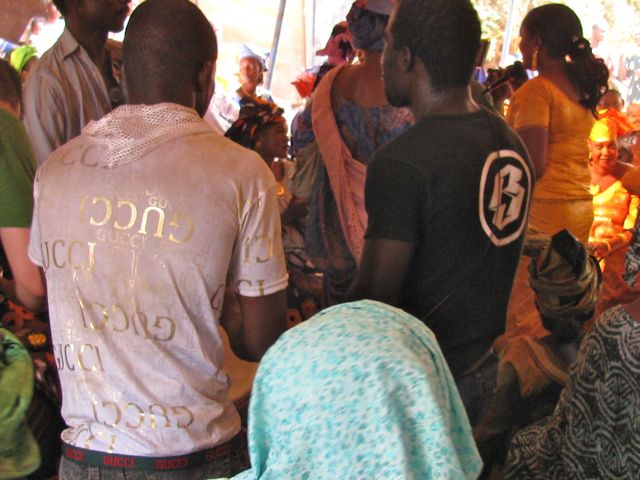
In Bamako on Sunday, I got to a wedding event (they spread through the weekend) where the families gathered and griots sang their praises. Griot is sometimes translated as "storyteller," and as a caste they have a fascinating and precarious place in Mali society and across West Africa: they traditionally depend on the patronage of wealthy families whose stories they sing at events, but they also sometimes speak truth to power.
    In this photo the female griot at right sings praises to the accompaniment of the djembe drummers in the foreground.
In Griot Time    Banning Eyre's book, In Griot Time, is a fun way into his story of learning Malian guitar from griots.
    In a growing global push against malaria, some health advocacy campaigns in Mali have enlisted griots. Recognizing how they have the ear of everyday people and thought leaders, the campaigns invite griots to integrate lyrics about how mosquito nets help protect children from getting malaria into their work. Some griots at the local-level have included that messaging at wedding gigs.

Monday, March 21, 2011

Now for Something Completely Different

Now in West Africa for a month with an IRP reporting fellowship, and just getting my bearings in Mali's capital with a walk through the main market. Two quick and simple observations on the changes since Richard Wright's tour of these countries at independence just over a half century ago:
1) West African fashion is timeless but changes in communication and public relations move at warp speed (I exaggerate). Witness the teeming boys on every corner selling cellphone minutes, and a heightened perception by everyone here of how the world sees images from Africa. They know journalists usually go for the poverty-makes-sympathy shot.
    Twice I framed a photo and got the stink eye. First an older man insisted I pay for the opportunity (he relented when I sounded incredulous about paying a building to take its picture). Then a teenage girl said my shot of people at a railroad crossing was "pas beau" -- not pretty. Both showed a consciousness of putting Mali's best foot forward and not getting exploited.
2) Impressive variety of food in the popular market. Where are they growing cool-weather items like lettuce? Lots of potatoes, garlic, tomatoes, mangoes, beets, peppers, fish of various sizes, and much more. And this is the hot season when wind kicks up dust and the temp spills over 100F.
The billboard for the cellphone and Internet service provider says 'Business is Everywhere.'

Monday, March 7, 2011

Reporting on Civil War in the Mediterranean

An amazing exhibit at the International Center for Photography in New York captures the images of three photojournalists as they peered through their lenses at the Spanish Civil War. All three came from elsewhere in Europe: Robert Capa, born in Hungary; Gerda Taro from Germany; and David Seymour (aka Chim) from Poland.
    The Spanish Civil War itself came from elsewhere in some ways. Many across Europe saw it as a foretaste of the ideological battle looming for the rest of Europe, between Fascism and its opponents. Hitler and Mussolini backed Francisco Franco’s army. The Soviet Union and communists elsewhere supported the Republican forces. For many progressive Americans, volunteering in the “Lincoln brigade” in Spain to support the Republic was a test of ideals.
    The Mexican Suitcase exhibit is dramatic for its story of how the photographers came together in love and friendship in a war zone, as well as how their story in images became a time capsule, lost for decades before emerging from a single valise.
    It’s especially resonant now as another wave of violent change shakes Libya and the Mediterranean.
    For many WPA writers in the U.S., the Spanish Civil War posed a crisis of conscience: Would they go abroad and put their lives on the line for fellow travelers for the cause of a more egalitarian world? Richard Wright wrote his friend Nelson Algren back in Chicago, asking that very question.
    In California, WPA writer Eluard Luchell McDaniel was one who responded. He had run away from Mississippi at age 10 and worked his way across America, growing up through odd jobs along the way, and writing. After gaining notice when his fiction appeared in Story magazine in 1935, he went to fight with the Abraham Lincoln Brigade before returning to San Francisco.
    Just as it did when Gerda Taro lost her life covering the war in Spain, bearing witness can still mean risking everything. Recently photojournalist and former IRP fellow Chris Hondros died while covering the civil war in Libya. Read about him and the continuing perils of war reporting here.

Tuesday, January 18, 2011

Patti Smith and Mari Sandoz, Kindred Spirits

In her wonderful memoir Just Kids, Patti Smith honors inspiration she gained from another writer during her formative time living in the Chelsea Hotel:
I thought of something I learned from reading Crazy Horse: The Strange Man of the Oglalas by Mari Sandoz. Crazy Horse believes that he will be victorious in battle, but if he stops to take spoils from the battlefield, he will be defeated. He tattoos lightning bolts on the ears of his horses so the sight of them will remind him of this as he rides. I tried to apply this lesson to the things at hand, careful not to take spoils that were not rightfully mine. I decided I wanted a similar tattoo.
Such an insight about Crazy Horse is just the thing that attracted readers to Sandoz, a daughter of Swiss immigrants in the sandhills of western Nebraska. Like Smith herself, Sandoz overcame huge obstacles to become a writer. Her own father once told her, "You know I consider writers and artists the maggots of society."
    Sandoz grew up on a farm near the Sioux reservation at Pine Ridge, and they were part of her childhood. "I remember the stern faces of the Sioux when in the swift heat of temper my father whipped us," she recalled later. "These Indians still consider the whites a brutal people who treat their children like enemies …"
    One day, walking home with a bundle of wood, she came upon an old Sioux man and stopped to watch as he danced alone. The old warrior called her "granddaughter" and told her his story.
    Later as a colleague and friend of WPA folklore director Ben Botkin, Sandoz blazed new trails in her interviews for her biography of Crazy Horse. She was considered for the job of state director of the WPA Writers’ Project in Nebraska.
    Rudolph Umland, a young WPA editor in Lincoln, saw Sandoz as a mentor and respected the toughness she showed from her youth on the farm. Years later he still remembered her stories of growing up poor, wearing dresses made from flour sacks and old men’s shoes laced with twine.
    "She knew what it was like to be made fun of," Umland wrote. "No woman bent on being a literary person ever had the cards stacked against her more ... She once showed me a knot on her hand that came from a bone broken during one of [her father's] beatings."
    In the 1930s, her book about her father, Old Jules, won the prestigious Atlantic Press nonfiction prize. Sandoz became a leading Nebraska author, and hosted social gatherings of younger writers in her Lincoln apartment. The topics ranged from writing dialogue to demonstrations of Polish dances she had learned as a girl.
    Sandoz belonged to no group or movement, but savored these discussions with younger writers.
    "There were an awful lot of young creative people around," she said of 1930s Lincoln in a 1961 interview. "We were angry over the suppression of ideas in America."
    By the 1960s, Sandoz was living in Greenwich Village, not far from where Patti Smith later took up residence in the Chelsea. Sandoz's spirit was honored by Umland and his colleagues in the Nebraska WPA guide, which ranked her Old Jules among the most important pieces of prose from Nebraska since Willa Cather’s novels. "Mari Sandoz treats epic material boldly," says the guide, "with scrupulous honesty."
Tuesday, January 11, 2011

WPA Guide Appreciators week continues

While we're on the topic of people who value the WPA guides, here's a post by El Prez about his battered copy of the WPA Almanac for New Yorkers, 1938. Bought from a sidewalk vendor years ago, it includes an inscription from M.W. Wellman, one of the WPA writers who worked on it, inscribed with holiday wishes to "one of his debtors." Wellman even points the reader to pages with good and bad jokes. Possibly the same M.W. Wellman who wrote several issues of Strange Adventures for DC Comics in 1951?
    El Prez noticed that 1938 and 2011 align not just in their parallel hard times, but in the dates and days of the week. He found the New York Times beat him to the idea of providing a scan of the 1938 almanac for people in 2011 to use. Thanks, Gray Lady!

Saturday, January 8, 2011

Oklahoma lawyer and the WPA guide

I'm curious about this blog, Oklahoma DUI Lawyer, and why a recent post features a 1986 reprint of the WPA guide to Oklahoma. Straightforward description of the book: just the facts, ma'am. But still intriguing ...

Monday, January 3, 2011

De Niro Art Goes Back to the WPA

Actor Robert De Niro's parents were both artists with the WPA in New York in the 1930s when the arts program helped many get through the Depression. Other WPA artists then included Willem de Kooning and Jackson Pollock. Robert De Niro Sr.'s art works made news recently when the actor took control as manager of his father's art legacy. His mother, Virginia Admiral, was a poet as well as a painter. Both parents belonged to the Greenwich Village art community. This article about New York abstract expressionism recounts the roots of that group in the Federal Art Project; the 2006 De Kooning biography gives a good feel for it.
August 2014 postscript: A new HBO documentary about Robert De Niro, Sr. traces his beginnings and study with Hans Hofmann in Massachusetts, his promising first exhibitions, as well as his later struggles and his relationship with his son. Watch the trailer at www.rememberingtheartist.com.