Starting a new workshop at The Writer’s Center (and speaking at a book festival next weekend) has me rethinking the writing process. It's been a while since my piece for the Center about ways to nurture creativity amid daily life, so this is an update. It starts with the adage from Samuel “Sunshine” Beckett, quoted by Amy Bloom: “Try. Fail. Try again. Fail better.” For me, creativity boils down to a handful of practices:
1. Make the time. Hoard your best hours for your own project. Are you most creative when you wake? Mark off an hour then. Late at night? Stay up. The rest of the day, use time wisely.
2. Find creative people and listen to them. Your peers (I started with a group from The Writer’s Center) are priceless for feedback and for self-imposed deadlines that help to motivate. I don’t always like other people's feedback at first but I suspend judgment until the next day.
3. Know when you’re drafting and when you’re revising. When you start a work, let it come out so you can see on the page the material that you can work with. When it has cooled, go back and allow yourself to tear it apart - that is, to edit and revise. I think of it like a train: To get started, unhook the drafting engine from the editing brakes. The brakes work best later when it’s underway.
4. Follow the links from small to large. Short stories can lead to a collection. An article can lead to book, maybe to film. Post this motto somewhere where you see it: “By the yard, it’s hard. By the inch, it’s a cinch.” Allow yourself to take small bites. Writing an article may not capture the entire epic that you see in your mind, but getting an article published can help focus it.
5. Do the paperwork. Submitting stories to journals and contests doesn’t sound creative, it sounds tedious. And full of rejection. But pick a few, put the deadlines on the calendar, give it time, and send them off. (Don’t calculate the odds. They’re never good.) Then forget them. When one comes back, send it out again; when one succeeds, your creativity gets the world's stamp of approval.
Thanks to Sunil Freeman at The Writer's Center blog, First Person Plural, for posting my piece on how crisis shapes character, and can make a compelling documentary. Case in point: Moses Asch, who founded Folkways Records. Have a look here.
Black history is detective work, uncovering clues and putting together narratives that survived underground for generations, or sometimes in plain view but unrecognized by historians. Dr. Ann Robinson has documented African American life and history in New Haven this way for over 40 years. Along the way she has found and championed new connections between the past and present and sometimes, like last summer, opening a new door between them.
A North Carolina-born psychology professor and community historian in New Haven’s Dixwell neighborhood, she grew up seeing African-American Masons in her community as remote, notwithstanding that her father was one. She and her husband Charles moved in August 1967 to New Haven, where he taught at Yale’s medical school and she taught first at Trinity College and then Gateway Community College.
She wrote a column for the New Haven Register, “As I See It,” to give voices inside the black community. Her daughter Angela Robinson became a superior court judge, the youngest ever appointed.
During that whole time the city saw riots, assassinations and New Haven’s Black Panther trial. Freemasons seemed even more irrelevant. So she was startled when, in the 1990s, the local Prince Hall Masons contacted her to help prepare their lodge to join the Connecticut Freedom Trail.
From her father, she knew African-American Freemasonry went back to Prince Hall, the freedman who founded a chapter in Boston. When white American Masons refused to admit Hall and 14 other black applicants, they started their own lodge with authority from the Masons of Great Britain. Yet for over 200 years, American Freemasonry, with a core tenet of universal brotherhood, was segregated by race.
It was also segregated by gender. “It was a secret society,” she said, “closed to women.”
Soon after she was invited, however, she took a tour inside the Widow’s Son Lodge, an old brick building on Goffe Street that she had never felt welcome enough to enter. She walked into the foyer and encountered a life-size bust over six feet tall, with a forbidding expression. She continued on to the main room – there was the same man again, this time in a large oil portrait on the wall. She couldn’t tell if he were white or black. She could only see that he was stiff and formal. Who was this? Robinson wondered.
Robinson told me this two years ago when our detective work intersected. In the course of other research I had come across the papers of African-American lawyer George Crawford, a co-founder with W.E.B. Du Bois of the NAACP and a core member of its predecessor, the Niagara Movement. Through a series of phone calls I had found a protégé of Crawford’s in the Prince Hall Masons, who suggested I talk with Dr. Robinson.
I phoned her standing on York Street as snow came down. She politely put me through a vetting. Who was I? Was I African-American? I replied that I was a white male writer (exactly the kind who had stolen stories before). I explained my background and my work. After ten minutes, she invited me over to talk.
The woman who came to the door was youthful-looking, in a terra-cotta colored dress and short grey dreadlocks. She was formidably articulate. Her husband Charles took my coat, and when his wife mistakenly introduced me as a Mason he tried to shake my hand with the Masonic handshake until I explained that no, I’m not a Mason.
We sat in their living room and talked about the man whose bust had so commanded the Prince Hall Masonic Lodge: George Crawford. She was surprised to learn that he had been born in Alabama, had started life as a Southerner like her, had actually had a hand in anything like civil rights activism.
“I thought until yesterday he was indigenous to New Haven,” she said.
Then she considered. “How did he change New Haven?” Maybe through his legal opinions. Certainly the Masons seemed to be “his constituency.”
She listened as I explained what I had found in the Yale library collection: his correspondence with Du Bois, the clippings of his "firsts" – first African-American to head Connecticut’s draft board in World War II (when he instituted advances for black soldiers), first African-American to take a prominent position in a city government anywhere in the state. One scrapbook held a cable from President Kennedy dated June 1963 inviting him to the White House for a discussion of civil rights. Yet his scrapbooks also held painful mementos. With what emotion had he pasted in a cartoon from his hometown, the Birmingham Herald, with a caricature of him as an ape, its only recognition of his triumph as one of the first black law graduates from Yale?
Crawford’s friendships stretched from his headmaster at Tuskegee, Booker T. Washington, to Du Bois and the NAACP, and on to Thurgood Marshall, his protégé in Prince Hall Masonry and the younger lawyer who delivered the triumph of Brown v. Board of Education 50 years after Crawford had stood with Du Bois for a more assertive brand of leadership for equality.
Later Ann Robinson brought our talk full circle: She and Charles opened the doors of the Prince Hall lodge to the public for a walking tour in the city’s International Arts & Ideas Festival. So that one Sunday afternoon I walked up steps to a door that had been locked before, and it opened. Above us in the foyer stood the bust of George Crawford, chin up, Masonic cap in place, a rather defiant welcome to visitors.
Dr. Ann Robinson (second from left) with other hosts of the event at the Prince Hall Masonic lodge.
Watch the short video to see more of the connections, and dig deeper into history.
In the 1930s young people with little experience, like Margaret Walker, Nelson Algren and Richard Wright, got on their feet with jobs as WPA writers. Working for the government on the American Guides, they got a firsthand sense of what creatives can contribute to society.
Walker was just out of college when she applied to the Writers’ Project. She had grown up in segregated Alabama, a minister’s daughter, and after college she prepared to follow her mother’s path and marry a young minister. But her mother urged her to chart a new course. So Margaret lied about her age and got a spot as a WPA writer, meeting up with other young writers Richard Wright and Nelson Algren.
Wright, too, came from the South, moving with his mother from Mississippi to Memphis to Chicago where he found work with the post office despite having just seven years of school. In time he would become the poet of the Great Migration, as Isabel Wilkerson writes in The Warmth of Other Suns (the title comes from Wright).
What struck me in their letters and writings as I researched Soul of a People was how that moment in Chicago allowed them to connect with other writers across conventional divides of race, gender, age and education.
The Chicago office, Walker wrote later in Richard Wright: Daemonic Genius, fostered “what nobody believed was possible at that time -- a renaissance of the arts and American culture… and some of the most valued friendships in the literary history of the period.” She said in that moment she saw an end to the “long isolation of the Negro artist.”
Wright mapped his move from Chicago to New York in 1937 as his road to a literary career. “When I go tonight, I will have forty dollars in my pocket,” he told Walker as they rode the El his last night in Chicago, after leaving the WPA office. Wright planned to get a transfer to the agency’s office in Manhattan, but there were no guarantees. “I hope I’m not making a mistake, going this way,” he told Walker.
It wasn't a mistake. And after he burst on the scene with Uncle Tom’s Children and followed it with the bestseller Native Son (which benefitted from Walker’s research on a murder trial in Chicago), Wright remembered his friends in Chicago. He kept up a lively dialogue with Nelson Algren for years (see this piece in the American Scholar), and mentored other young writers. But Wright was a complex and conflicted personality, and no relationship was easy.
Their story unfolds against a backdrop of suspicion and controversy
that swirled around the Writers’ Project, as Texas congressman Martin Dies led a congressional investigation by the House Committee Investigating Un-American
Activities. In 1939 he brought his investigation to Chicago,
interrogating witnesses and raiding offices across the city. When Dies
brandished what he claimed was a list of suspected un-Americans in
Chicago, it included 514 milkmen, 144 newspaper reporters, 112 lawyers,
and 161 radio workers – people just as likely to be on a list of
interviews by the WPA writers for publication in the American Guides.
These creative, political and personal tensions and vitality lie at the heart of My People, which gets a stage reading in the WGA Screenplay Reading series on January 9, 2013 at the Players Club in New York. I’m thrilled that the screenplay, co-written with veteran screenwriter Jim McGrath, will bring the little-known story of these taut relationships involving Walker, Algren and Wright to a new audience.
In one of the last hurrahs of the Woody Guthrie centennial,
a festival in Germany honored him today. The festival description points up his
influence and his mythic stature internationally, and draws links from his
Dust Bowl ballads to the Occupy Movement, and from Alan Lomax to Bob Dylan.
For me it was fascinating to study Guthrie as a key figure
in Worlds of Sound: The Ballad of Folkways, and to see how the Folkways label was a key player in his own
rise and influence. (You can watch the whole film on iTunes.) I still find parts of Woody Guthrie: A Lifehaunting. Happy Hundred, Woody. Or rather, Glückliche Hundert.
I’ve always gotten a strong feeling from walking through cemeteries, but I never realized why until I looked into two very different cemeteries in New Orleans.
My visit 15 years ago started at New Orleans’ oldest cemetery, St. Louis I. Its tall wrought iron and stone monuments are packed tightly on a grid of narrow graveled paths, and extend block after block. Right away, you can see how it suits the urban traditions of the tradespeople and city elders buried there. On my tour, we found the marble tomb of Homer Plessy, the shoemaker who became famous in 1896 during the Supreme Court case Plessy v. Ferguson. Plessy was a civic-minded Creole tradesman who belonged to two community associations. Those groups supported him in his historic legal fight against segregation.
These associations were another New Orleans tradition. They arranged picnics and dances, but their most important role was a sort of funeral insurance, to provide a suitable wake and funeral for members. At least one brass band and uniformed mourners would accompany the family on the "last mile" with the body. After standing by Plessy during his lifetime, they walked beside him on his last ride in 1925 on the way to St Louis I.
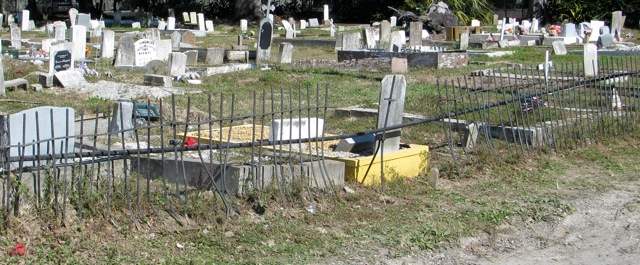
Things looked a lot different across town in Holt cemetery near the city park. Begun as a potters field, Holt is the final home of the city's poorest residents. You entered from a community college parking lot, into what at that time looked like an overgrown field. A hand-painted sign says "Holt cemetery".
Holt wasn't in any guidebook, but I knew that it was where Charles "Buddy" Bolden, the first "king" of jazz, was buried thanks in part to a note at the end of Michael Ondaatje’s fine novel, Coming Through Slaughter. Bolden was famous for his cornet playing and his charm with the women. A five-year-old Louis Armstrong heard King Bolden play and remembered the sound for the rest of his life. (Recently Treme honored him with an episode title, “I Thought I Heard Buddy Bolden Say.”) But Bolden’s career was cut short in 1906 by mental illness, and when he died in an institution many years later, all but forgotten, he was buried in Holt without ceremony or marker.
On my visit years ago, I found no sign of his grave. Instead I found a landscape of remembrance very different from St. Louis I, or any other I recognized. Graves in Holt are marked by plastic knickknacks and chinaware, like someone's picnic spot. These personalized markers spring from a rural African-American tradition and are as rich in their way as the marble in St Louis I. At many graves, loved ones have placed cups, saucers, bottles, rugs, bits of plaster. In that tradition, these items create a place where spirits of the departed can take rest and solace for their voyage.
But like their fellow citizens in St. Louis I, the departed in Holt need a funeral to send them on their way, and many poor families valued burial insurance more highly than health or accident insurance. Again, community associations provided it. Their brass bands nurtured Buddy Bolden's (and Armstrong’s) musical growth and shaped his repertoire. But when he died, there was no band to give him a proper goodbye. On Bolden’s 119th birthday, New Orleans made amends and gave Buddy Bolden a proper send-off. Delgado Community College organized the tribute, Stewart Enterprises donated a stone marker, and the Olympia Brass Band led a second-line parade of hundreds of New Orleanians and several television crews. A generation who never knew Bolden turned out to honor his memory because it said something about who they are and where they come from.
Now, his great-granddaughter said afterward, “he may be at peace.”
After years away, I stopped by Holt last weekend and visited Bolden’s fine marker, which seemed to honor also the other homemade markers surrounding it – the orange plastic flower, the child’s toys.
The stone called Bolden “legendary cornet player/ New Orleans jazz pioneer/ And first 'King of Jazz' and included Jelly Roll Morton's description of him: “The blowingest man since Gabriel.”
This Halloween let’s keep our ears peeled for those spirits. This is adapted from an article that first appeared in International Cemetery & Funeral Management magazine. That’s right.
Fifty years ago this week, the Cuban Missile Crisis
brought a Cold War nuclear threat to millions of American homes. To mark the anniversary,
the National Archives issued a new mobile app that lets you
listen to JFK's briefings about the aerial photographs that found Soviet
warheads in Cuba. But for 13-year-old Tim Warburton, the Crisis appeared as a traffic
phalanx rolling down a Florida highway.
His parents had divorced and his father,
restaurauteur Barclay Warburton III, was restoring himself by refurbishing a
yacht, the Black Pearl, in a Florida
boatyard. He brought his son for months to help. That October, the ride back to his father’s place after
school in Boca Raton seared on Tim’s brain the sight of a southbound convoy of
U.S. armed vehicles and personnel.
"I remember
the Sunshine State Parkway completely packed in the southbound lanes with
military trucks, men, missiles," he says. "It was unbelievable."
The U.S.
administration was scrambling to respond to a threat. By October 26, Kennedy
was prepared to invade Cuba to remove the Soviet missiles. The next evening the
high tensions led to a clandestine huddle of emissaries from Kennedy and Krushchev at a
Chinese restaurant in Washington, DC (now the Walgreen’s where I buy razor
blades). The following day, both parties stepped back from the brink.
The harrowing
episode left many people searching for another path, including Frank Braynard,
then on the staff of the American Merchant Marine Institute. Braynard, who
loved the great sailing ships that had all but disappeared from the ports, and
Nils Hansell, an I.B.M. employee and kindred, met in Braynard’s office at 11
Broadway and hatched a plan named Operation Sail. The name evoked romance and
intrigue of an intelligence effort, an absurd contrast with outmoded sea
transport, and the hope for an effort to foster international goodwill.
They wrote to
anyone who might help. Officials began to champion the idea. From Albany,
Governor Nelson Rockefeller issued letters to foreign dignitaries inviting them
to join Operation Sail 1964, "a project to bring the great school sail ships of
the world" to New York.Hansell's I.B.M. connections led to an
invitation from the White House staff. In 1963 Kennedy signed on. "Sailing has
given me some of the most pleasant and exciting moments of my life," Kennedy
wrote. "Thus I am looking forward to Operation
Sail. The sight of so many ships gathered from the corners of the world
should remind us that strength, discipline and venturesome men still can find
their way safely across uncertain and stormy seas."
Kennedy would never see that spectacle, but two years after
witnessing the defense machinery pass their boatyard, the Warburtons father and
son sailed the Black Pearl to New
York. In July 1964 New York hosted the first Operation Sail where dozens of
sailing ships from around the world came together alongside the futurescape of
the World's Fair. Warburton remembers the Fair
and the AT&T videophone
exhibited there.
Operation Sail gave him memories of great
square-riggers gathered at the Verrazano Bridge and Burl Ives, a family friend,
singing sea chanties up the Hudson. One clear,
painful memory involves a side competition among the ships: a rowing contest of
dinghies. "We had a terrible boat," he laughs. "I was an oarsman, and we were
last. By a long distance."
But the tall ships had a powerful effect on the
father. "That was his conversion," Tim told me for a book
on Operation Sail. The 1964 event marked the end of the Black Pearl's days as the yacht of a
playboy and the start of its mission as a sail-training vessel for young
people.
The sight of these ships gathering in the
wake of the Missile Crisis (and the shadow of Lyndon Johnson's doomsday '64 election campaign ad,
Daisy) hit
home. Barclay Warburton saw the sailing ships' arrival as a way for a new generation to
meet each other across borders and learn how others live. Warburton dedicated much
of his life to creating the American
Sail Training Association, a group that pursued that mission. Another
Operation Sail brought the ships to New York and other U.S. ports this summer (including the Indonesian vessel Dewaruci, on its last epic seven-seas journey),
where the vessels of a bygone era paraded once again, ghostly reminders of
other showdowns.
Author of Soul of a People: The WPA Writers' Project Uncovers Depression America and writer and co-producer of the Smithsonian documentary, Soul of a People: Writing America's Story. Co-author of The War of 1812 and the Rise of the U.S. Navy. I lead workshops at The Writer's Center in Bethesda, MD. www.davidataylor.com
 the next day.




 Posts
Posts

